A physical office isn’t just another cost centre; it is a strategic tool to attract talent and support operational agility for businesses. In highly competitive cities, many businesses face a common dilemma of trying to reconcile the dream of an expansive, airy office with the functional and financial realities of local commercial real estate.
The average Grade A office typically offers floor-to-ceiling heights of 2.6 to 3.0 meters which can feel restrictive for brands wanting to make a bold statement. On the other hand, business parks and high-spec industrial spaces may provide a generous clearance of 4 to 5 meters.
Whether you are in a standard CBD tower or a high spec industrial park, the way spatial height of an office space is managed can be the difference between a perceived cramped environment and a high-performance workspace. Each of these spaces comes with unique opportunities, but also significant financial considerations.
In this blog, we explore five creative ways you can utilise vertical spaces in office design to your advantage and what to watch out for.
Maximising Height in Standard Offices
Generous vertical spaces leverage the Cathedral Effect. Research shows that high ceilings play a vital role in how we think. While low ceilings encourage focus on detail, expansive vertical spaces naturally broaden perspectives, enabling your team to better connect abstract ideas.
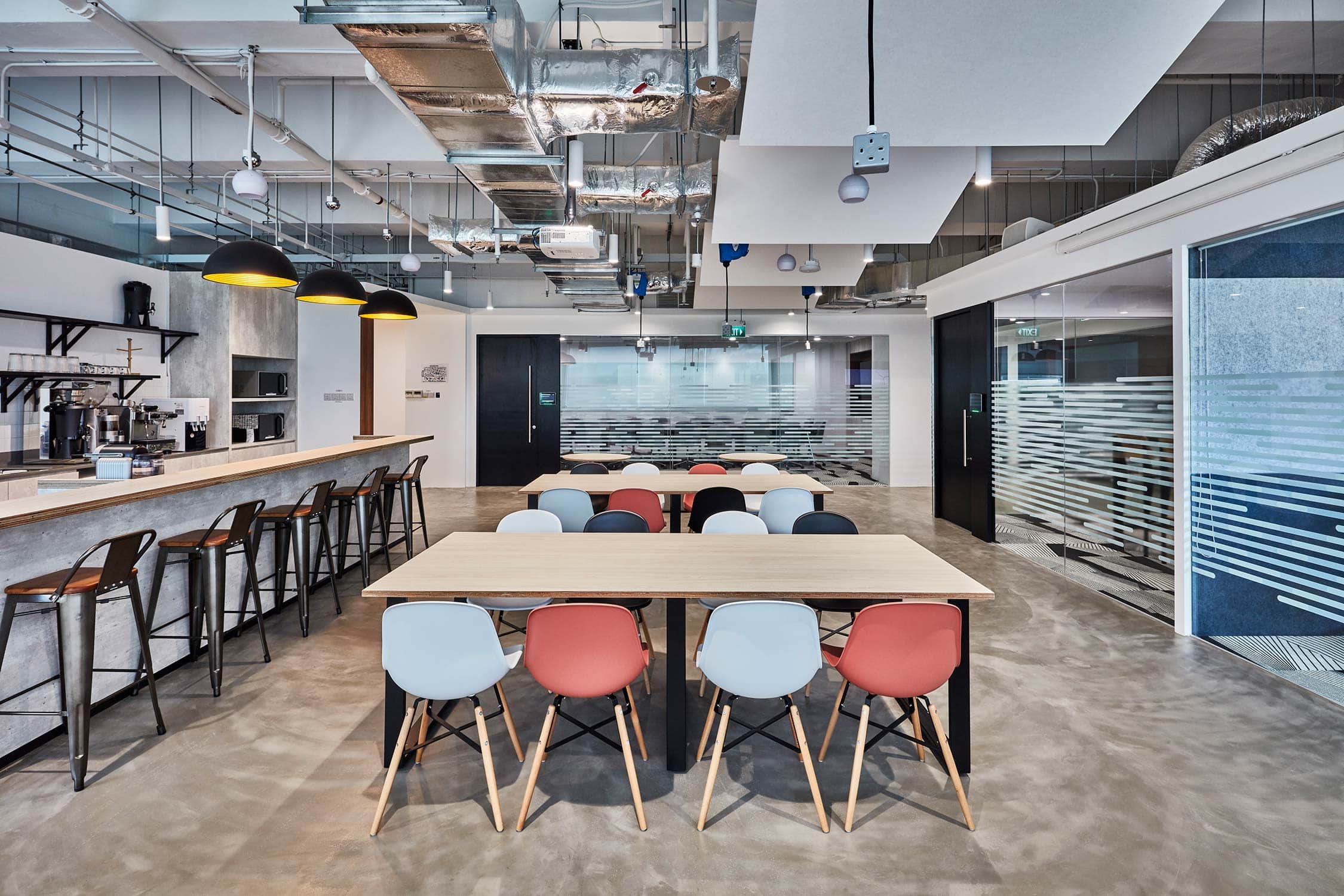
One common way to gain additional vertical volume in a standard office to achieve this effect is by removing the false ceiling to reveal the overhead services. This potentially adds an extra 40 to 50 centimeters of height. While this creates a modern, industrial feel, it is important to remember the cost of reinstatement.
When the lease ends, most landlords require the space to be returned to its original condition which requires putting the false ceiling back. Smart office design accounts for these exit costs during the initial planning phase.
Expanding the Use of Vertical Real Estate
Office spaces with more than 5-meter heights offer opportunities for your business to add new functional zones without dividing the floor plan. Instead of installing traditional partitions and walls, offices can add a mezzanine level to serve as a collaborative space or additional storage that removes clutter from the main floor. This keeps teams visually and socially connected within a shared environment.
While this is a great way to scale your headcount without moving, it does involve complex approvals including adherence to strict fire safety regulations. Beyond the build cost, the cost to dismantle and reinstate these structures at the end of a lease can be substantial.
For a more budget friendly option, vertical zoning can be explored to put the space to good use without the structural price tag.
Designing Flexible Zones Within Double-Height Office Spaces
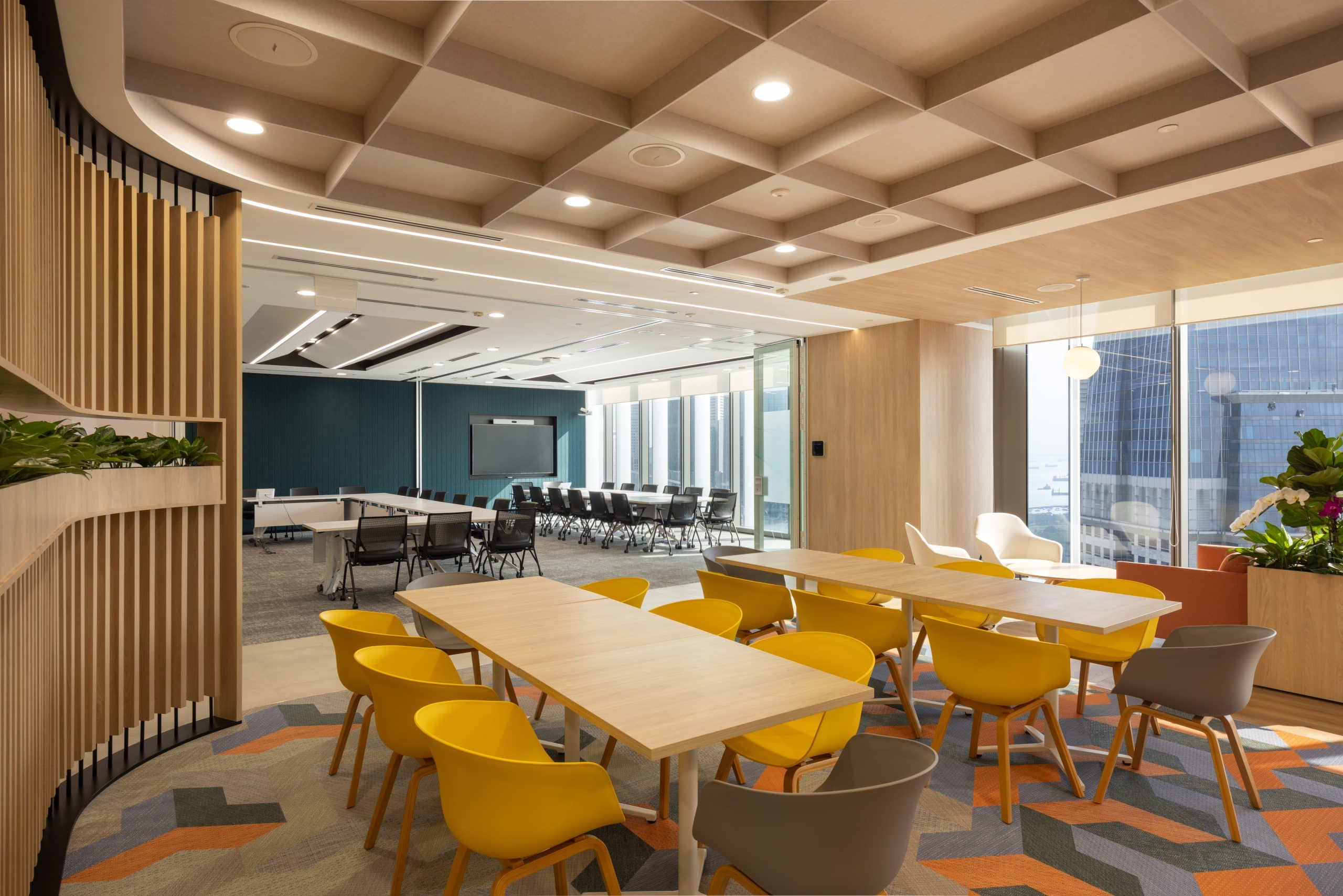
Designing for high ceiling workspaces requires intentionality. Double-height office spaces also present a unique opportunity to layer lighting and acoustics vertically, creating a 3D landscape that empowers your team’s creativity in ways a standard office cannot.
One of the ways to do this is by integrating pendant lights in your office interior design, which removes the need for physical barriers and visually anchors a workplace to the floor. In a grand space, lighting can help your team sustain focus.
Moreover, these spaces allow for suspended, low-hanging acoustic baffles to partition the area into intimate huddle spaces, capturing sound before it escapes into the rafters.
Using Vertical Space to Create Visual Impact and Identity
Another key component of a productive office lies in its aesthetics. The architecture of a space reveals your brand story.
This is often reflected in the height, scale, and proportion of your environment. While it may seem subtle, it can significantly reinforce your brand presence.
Vertical real estate offer a unique canvas to project your company’s vision, such as through floor-to-ceiling graphics, digital media walls or customised murals. Even better, there is room to create vertical gardens that solidify your sustainability goals while prioritising employee well-being.
These are the elements that shape your company’s identity, and they can be beautifully expressed through the usage of space.
Storage & Future Planning
Every industry is susceptible to change with little to no warning. The world that we operate in is dynamic, and this is precisely why maximising your vertical space for storage gives you a competitive advantage.
Offices with high ceilings allow for a degree of architectural flexibility. Rather than occupying premium floor area with traditional cupboards, double-height spaces enable the creation of expansive, floor-to-ceiling feature walls that double as high-capacity storage.
By utilising the full height of the room with integrated shelving, and maybe even a rolling library ladder if the height allows, you transform your space into a multi-functional landscape. This vertical approach keeps the primary workspace lean, effectively removing the physical and mental distractions of clutter that might stifle your team’s creativity.
Beyond that, storage spaces can be easily adapted for future expansion or growth, allowing you to scale your operations so that your office grows alongside your business.
If you’re looking to maximise the potential of your office space design, our office design services provide the ideal solution.
At Sennex, we specialise in transforming high-performance office spaces. With over two decades of experience, our human-centric approach is designed to bring out the best in your team, prioritising creativity and comfort in every facet of our design philosophy.
Contact us to get started today.
FAQ’s
Q: What is meant by vertical office space design?
A: Vertical office space design refers to interiors with significant height clearance – typically double-height ceilings or open, industrial-scale structures. Rather than just focusing on floor area, it treats the air or cubic volume as a functional asset for light, branding, and psychological openness.
Q: What are the benefits of high-ceiling office spaces in modern workplaces?
A: Architecturally, they provide better natural light and ventilation. Psychologically, they trigger the Cathedral Effect, a cognitive phenomenon where high ceilings encourage abstract thinking, creativity, and a sense of freedom, while lower ceilings are better for task-oriented detail work.
Q: How can double height office interiors be designed to maximise space in a cost-efficient manner?
A: You can achieve this by layering the space – using hanging lights or acoustic panels to bring the ceiling height down over desks. Adding furniture like high-backed booths also creates cosy, private nooks within the grand expanse without the costly build.
Q: What types of businesses benefit most from high ceiling office spaces?
A: Creative agencies, tech startups, and R&D firms benefit from the mental breathing room required for innovation. Additionally, e-commerce and logistics-heavy businesses benefit from the massive vertical storage potential that standard offices lack.
Q: How can creative office space utilisation improve employee experience?
A: By intentionally zoning a large space, you give employees a variety of environments: grand areas for social collaboration and quiet, acoustic-protected spaces for deep focus. This autonomy over where and how they work reduces stress and boosts overall job satisfaction.